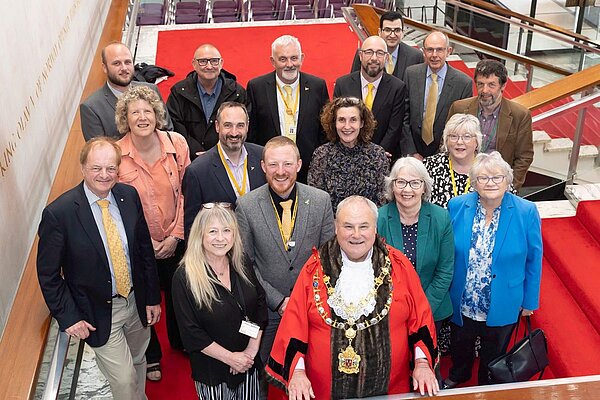
Our policy motions on Newcastle City Council
We regularly submit policy motions to meetings of Newcastle City Council.
Here's what we proposed in 2025 and early 2026.
Working for our City
2. Close the Student Council Tax Gap
3. Withdraw from TVERF waste incineration
4. Review of the Houses in Multiple Occupation Licence Fee
6. Delivering on the Movement Strategy
7. Unspent Infrastructure funds
10. 20 mph zones in residential streets
11. Winter Road and Pavement maintenance
12. Securing the future of Newcastle's Commercial Development Pipeline
13. Ending the two-tier maintenance of Newcastle's play areas
14. Improve Bus Services in Newcastle
16. Securing the Future of Newcastle Parks amenities
Engaging government on behalf of the people of Newcastle
5. Opposing Labour’s Digital ID Scheme
7. Police and Crime commissioner replacement
Working for our City
Urban Green Newcastle
Urban Green's activities with our Parks and Green spaces have been brought back into Council control without a clear plan on how they will be managed, or a reconciliation of what went right and wrong with Urban Green
Council notes with concern that:
1. proposals to bring Urban Green Newcastle's (UGN) activities “in house” have been discussed by cabinet without a clear statement of the impact on the council’s revenue or capital budget, compared with the position where UGN had met its objectives;
2. no explanation has been given as to why previous cabinets allowed significant transfers of cash to UGN with insufficient accountability, oversight or reporting;
3. No Cabinet member, past or present, has issued an apology or recognition of their role in the situation.
Council believes that:
1. Council taxpayers are owed an explanation as to why UGN was not set up with a robust and effective governance framework and oversight when it was handed significant assets and cash by the council;
2. The evidence shows the COVID pandemic was a factor in UGN's inability to meet income targets, but not the factor;
3. The failure to oversee and monitor arose from successive Cabinet decisions, up to and including the decision to remove elected member oversight from UGN's Board of Trustees.
Council resolves to:
1. Request a clear statement of the impact on the City's current and future revenue and capital budgets over the next five years, relating to UGN's establishment and subsequent dissolution;
2. Request that Cabinet issues an apology to residents of the City, employees of UGN, and park users, for how this matter has been dealt with since its inception.”
Proposed: Cllr PJ Morrissey
Close the Student Council Tax gap
The Lib Dems have identified a £21.8 million gap in funding from central government to compensate the council for lack of Student council tax. We propose to engage government to close this gap as soon as possible
Council notes that:
1. The Student Class N Council Tax exemption is a national policy that helps to support the accommodation costs of full-time students during their studies.
2. It receives some reimbursement from the DCLG via the Settlement Funding Assessment to compensate for the loss of Council Tax income, but that the student adjustment was fixed in 2013/14 and has not been updated since.
3. With the rise in Council Tax rates since 2013/14 and growing student numbers, the funding gap for 2024/25 was estimated to be £21.8 million for the city.
4. In response to a recent parliamentary question, HMG has indicated that they intend to use the consultation on the Fair Funding Review 2.0 to review the adjustments to the funding formula for local authorities with higher studentexempt properties.
Council believes that:
1. The review of the funding formula is a welcome first step, but that local authorities with high student populations, like Newcastle, should not disproportionately bear the costs of student Council Tax exemptions.
2. Students should continue to have the same access to Council services as all other residents and that the Class N exemption should continue.
Council resolves to:
1. Participate fully in the consultation process on the Fair Funding Review 2.0, making the case for the funding gap caused by Class N exemptions to be filled and that future funding assessments should reflect changes in Council Tax rates and student numbers.
2. Engage with similar authorities and others, locally and nationally, to jointly lobby HMG on this issue.
Proposed by: Cllr Peter Allen
Seconded by: Cllr James Coles
Withdraw from TVERF waste incineration
The Lib Dems are calling on the council to withdraw from the waste incineration project on Teeside, expanding incineration capacity at a time when we should be aiming to double our recycling does not make sense.
Council notes that:
1. in recent years, Newcastle domestic waste recycling rate has plummeted from over 42% to less than 25%, compared to the best performing Councils which recycle more than 60%.
2. simultaneously, the amount of domestic waste sent for incineration from Newcastle has risen to almost 50%
3. incineration is regarded as the second worst disposal route for waste after landfill
4. the Council is currently negotiating the procurement of a new waste incinerator on Teesside, known as TVERF, with 6 other Councils
5. the current plans for TVERF feature neither a district heating output nor carbon capture and storage (CCS).
6. the projected carbon emissions from TVERF would be the equivalent of 125,000 homes, and much more than the equivalent gas-fired power station in terms of the carbon intensity of the electricity it produces.
7. according to Government figures, projected incinerator capacity will exceed the country’s requirement by 1 million tonnes per annum by 2042.
Council believes that:
1. expanding incineration capacity at a time when the Council should be aiming to double our recycling rate is counter-productive.
2. “CCS-ready” is a meaningless claim.
3. a long term contract such as TVERF would lock us into incineration for decades, as the seven Councils would be obliged to provide a minimum amount of material of a suitable calorific value to burn.
Council resolves to:
Ask Cabinet to withdraw from the TVERF project.
Proposed: Councillor Kane
Review of the Houses in Multiple Occupation Licence Fee
The Lib Dems are proposing that Houses in Multiple Occupation (HMOs) need to be regulated in an affordable manner for the city, that takes into account the real cost of enforcement and administration.
Council recognises that: -
1. Mandatory House of Multiple Occupation (HMO) licensing applies to all HMOs with five or more tenants living in two or more households who share facilities such as a kitchen or a bathroom.
2. the Additional and Mandatory HMO Licence Fees for landlords amount to £1,100 every five years, at most, and that discounts are available to lower that sum.
3. the average income to the city is around £300,000 per year from the HMO licensing scheme.
4. the revenue generated is designed to cover the enforcement and administration of the HMO licensing scheme.
5. raising revenue ensures a properly funded licensing and enforcement function to protect the rights of the renters.
Council resolves to:
1. conduct a prompt review of the Mandatory HMO Licence Fee to ensure it sufficiently and adequately covers the true cost of enforcement and administration of the scheme.
2. engage meaningfully with other local authorities to conduct a review of Mandatory HMO Licence Fees in England.
3. review the model to account for HMOs with different numbers of occupants.
4. raise this as a matter of urgency with the Minister of State for Local Government and English Devolution.
5. refer the review of the Mandatory HMO licensing scheme to the Overview and Scrutiny committee for examination.
Proposed: Cllr James Coles
Seconded: Cllr Browne
Improving Council Services
The Lib Dems are challenging the Labour administration to focus on quality of delivery in Local Services and to create and share a robust action plan to address the needs across the city.
Council notes that:
1. Successive Conservative and Labour Prime Ministers have led national governments that have paid little interest to local government over the last decade;
2. Local government finance is widely agreed on a cross-party basis to no longer be fit for purpose, either in terms of local revenue raising powers or central government grant;
3. These factors have combined to put enormous pressure on councils to deliver statutory services in constrained circumstances.
Nevertheless, Council believes that:
1. The Labour Administration of 2011 to 2026 has chosen to pursue a narrative based on the perceived pain of budget cuts and to focus service transformation on measures that save money, without regard to quality of delivery;
2. Some frontline services are now the subject of regular dissatisfaction amongst the council tax paying public, including management of fly tipping, weed control, tackling littering, and the availability of litter bins; the state of pavements, back alleys and roads; the general state of parks and other common areas across the city; the length of time to access council services such as pest control, white goods collection; the unaffordable charges for some council services; and the general difficulty in accessing Council services outside of digital channels;
3. Labour's chosen narrative does not support the Council to achieve a qualityfirst view of delivery of frontline services.
Council further notes that:
Recent Scrutiny-led exercises to consider the Council's grass cutting regime led to perceivable and well-received service-level improvements.
Council resolves to:
1. Ask Cabinet to demonstrate a commitment to quality-first view of service delivery by delivering an action plan to tackle the blight of uncontrolled weed growth that residents have seen across the city this summer; and to
2. Request that this action plan is presented to the appropriate Scrutiny Committee or to City Council for full review.
Proposed: Councillor Mark Mitchell
Delivering on the Movement Strategy
The Lib Dems are asking the Cabinet to deliver quick wins on automatic traffic signals and bus stop parking restrictions to make it easier and faster to choose more sustainable modes of transport
Council recognises that:
1. Cabinet have recently approved the Movement Strategy, which aims to improve transport and shape the way we travel up to 2045. It focuses on creating a transport network that is inclusive, green, and promotes active travel.
2. Ensure people can travel easily by providing viable alternatives to car travel, while recognising that cars will remain an important part of travelling for some.
3. Put people and inclusivity at the heart of transport planning, ensuring people with mobility challenges are included
4. Improve the sustainable travel options in the city so people can naturally make the choice to walk, wheel, ride a bike or use public transport.
5. Work closely with others to develop holistic and integrated transport solutions. o Align transport with broader city outcomes such as city growth, health and environmental considerations. o Encourage innovative evidence-based transport planning that supports the wellbeing of our communities.
Council notes that:
We will have to wait for an Implementation Plan and funding but that there are some quick wins that would demonstrate the Council’s commitment to putting people and inclusivity at the heart of Transport Planning, that could be delivered at modest cost.
Council resolves to ask Cabinet to deliver the following quick wins:
1. To extend parking restrictions at all Bus Stops from the current time limited restriction, to operate 24 hours a day, 7 days a week, to prioritise Public Transport over private car parking, and ensure that buses can get to the raised kerbs to deploy boarding ramps.
2. To adjust the timing on all automatic traffic signals with a pedestrian phase to remove any timed delay, or delay that prioritises traffic, to ensure that pedestrians waiting to cross the road are not held up unduly
3. To set a presumption that the default should be to adjust the timing on all automatic traffic signals with a pedestrian phase where there is a staged crossing, i.e. it takes two or more sets of light changes to cross a road, so that the pedestrian phase happens between each phase for drivers.
4. To adjust the timing on all automatic traffic signals with a pedestrian phase to ensure that the “green man” is illuminated for at least the time it takes to walk across the road at 1.2m/second (as listed in the DfT Guidance).
Proposed by: Councillor Cookson
Seconded by: Councillor Kane
Unspent Infrastructure funds (Section 106)
The Lib Dems are challenging the Cabinet to create a timetable for delivery of unspent infrastructure funding, and to improve the councils capacity to deliver capital projects on time.
Council notes that:
1. The recent Section 106 Contributions and Community Infrastructure Levy Performance Update – September 2024 to September 2025 report to Planning Committee (October 2025) indicates more than £42m of unspent Section 106 funds for infrastructure including £9.94m for affordable housing, £11.87m for education, £10.64m for transport, and £1.42m for open space, green infrastructure, and ecology improvements
2. This represents an increase of over 30% in the unspent S106 total for Newcastle disclosed in a national FOI request to local authorities in England in 2023, which indicated an unspent sum of circa £32m
Council further notes that:
1. S106 commitments are specified in legal agreements with developers in lieu of them building affordable housing and supporting local infrastructure and amenities related to their developments
2. S106 commitments are often earmarked for specific improvements to infrastructure required to support housing development including highways improvements, public transport infrastructure, education and health facilities, and community facilities, but funds for affordable housing can often be spent “off-site”
3. The dissatisfaction in new build housing areas of the city that the housing has been built but that essential supporting infrastructure has not yet been delivered, including in areas such as the Great Park and Callerton
4. Performance Report figures showing that the council has spent around 10% of its available s106 funding for affordable housing, transportation and bus services, around 30% of its available funding for education and health facilities, and only 6% of its available funding for open space, green infrastructure, and ecology improvements is a cause for concern
5. Liberal Democrat Opposition councillors have corresponded and met with planning department officers about the council’s approach to committing this underspend (October 2023) and tabled questions to council on the hold-ups on delivery of S106 on the Great Park (November 2024)
6. Despite these efforts, delays continue in commitment of the unspent S106 funding and delivery of the associated infrastructure
7. This situation has implications for the delivery of current and future housing site allocations and infrastructure
Council believes that:
1. S106 funds are intended to be spent on delivering affordable housing, schools, health facilities, roads and public amenities, not sitting in city council accounts
2. The public’s concern that the council has a significant and increasing sum of unspent S106 funding at a time of significant budget pressure is legitimate
3. It is important to give confidence to the public and stakeholders that the situation is being addressed both in respect of existing agreements and in respect of the commitments likely to arise over the lifetime of the forthcoming Local Plan
4. Urgency needs to be given to identifying how the council can overcome holdups to committing expenditure and delivering agreed commitments
Council resolves to:
1. Request an urgent Cabinet report setting out how the administration proposes to address this situation, to include:
2. A breakdown of existing S106 commitments
3. A frank assessment of what needs to be done to improve the council’s capacity to deliver capital projects expeditiously
4. A timetable for allocation and use by 2030 of the whole of the council’s existing unspent S106 funding
5. An action plan to overcome obstacles to delivery of promised infrastructure to be funded through S106 contributions
6. Recommendations for ensuring this situation does not arise in respect of major new housing development anticipated to be required in the forthcoming Local Plan.
Proposed by: Councillor Stone
Seconded by: Councillor Mark Mitchell
Short Term rentals
The Lib Dems are asking the Cabinet to report on how the growing number of short-term rentals should be managed across the city and whether they ought to be managed with more robust planning permissions
Council notes that:
1. AirBnB and other short-term rentals can provide useful accommodation options for visitors to Newcastle, for example providing family-friendly accommodation which is more appropriate than hotels or B&Bs;
2. Short term rentals in residential areas can cause significant issues with parking, antisocial behaviour, property upkeep and overall impact on residents.
3. Currently short-term rentals in Newcastle are largely unregulated.
4. The current system of business rates means that identifying short-term rental properties can result in a loss of revenue to the Council if owners opt to pay business rates rather than Council Tax;
5. Other Councils are already considering how the upcoming government proposals would impact and affect their areas.
Council welcomes:
1. Government proposals to introduce a national register for short-term letting properties and a new use class (C5) for short term lettings;
2. Government proposals to allow Councils to use Article 4 directions to require "change of use" to short term rentals.
Council believes:
It would be appropriate to consider how the new powers available should be used in Newcastle. Council resolves to call upon Cabinet to report the following to the Council:
1. Consideration of how existing information, or a review of available information, would allow an estimate of the current numbers of short-term rentals currently operating in each ward in Newcastle (as an example, there appear to be over 800 AirBnB properties available for Newcastle and the surrounding area for the last weekend in November of which 350 refer to "separate homes");
2. Estimation of the loss of revenue to the Council that could be caused if all short-term rentals in the city opted to pay business rates rather than Council Tax;
3. Preparation for implementation of the proposed national registry;
4. Consideration of using an Article 4 Direction to require planning permission for a change from C3 to C5 either across the city or in specified areas, and the impact thereof;
5. A review whether short term lettings will otherwise constitute permitted development across the City.”
Proposed by: Councillor Huddart
Seconded by: Councillor Mark Mitchell
Expansion of HMO controls
The Lib Dems are challenging the process for the conversion of "Family dwellings" to "Houses in Multiple Occupation" and seeking better regulation to manage such transitions.
Council recognises that:
1. An Article 4 direction is a direction under Article 4 of the Town and Country Planning (General Permitted Development) Order 2015 which enables local planning authorities to withdraw specific permitted development rights relating to operational development or changes of use across a defined area.
2. There are currently three Article 4 directions which control changes of use from Class C3 (“family dwelling”) to C4 (house in multiple occupation) in Newcastle.
3. In certain areas of Newcastle, planning permission is currently required to turn a family dwelling into a house in multiple occupation, under an Article 4 direction.
4. The purpose of the scheme is to ensure that specific applications are adequately publicised, scrutinised and that the local community may review those proposals.
Council resolves to ask Cabinet to:
1. Move to a full extension of the Article 4 Directions governing the conversion of Class C3 dwellings to Class C4 houses of multiple occupancy to cover the whole of Newcastle.
2. Engage meaningfully with other local authorities to conduct a thorough review of the benefits of such Article 4 Directions in England.
Council further resolves to:
1. Raise the continued conversions of Class C3 dwellings to Class C4 HMOs as a matter of urgency with the Minister of State for Housing and Planning.
2. Ask the Place Scrutiny Committee to consider adding a review of the Article 4 Directions scheme into the committee work programme.
Proposed by: Councillor Coles
Seconded by: Councillor Mark Mitchell
20 mph zones in residential streets
The Lib Dems supported a motion to increase signage in 20mph zones and an awareness campaign to reinforce the risks of speeding.
The Council Notes:
1. In 2006 the Council at the time introduced 20mph speed zones for 200 streets in the city. This initiative was known as ‘Twenty’s Plenty’. At that time, it was not enforceable but was a way to improve public safety. After this and changes to Government guidance a mandatory speed limit of 20mph was introduced across the city in residential streets.
2. In a lot of cases whilst it has brought down the average speed and without doubt improved safety for all, there remains the issue of speeding in many wards across the City.
Council Further Notes:
1. Based on accident data the Council can place a series of traffic calming measures to physically reduce speed. However, this is often costly and with limited funds could only be implemented on very few streets which would not address the wider issue.
2. Other Councils like North Tyneside have driver feedback signs which are placed on the actual street light column which is easy to connect and disconnect thus enabling them to be moved around with ease.
3. There is also the issue of increasing repeater signs on street light columns showing the speed limit, which can be increased.
4. Also, the use of painting slow markings on the carriageway on the approach to a bend.
Council resolves to ask Cabinet to:
1. Look at the examples of other Councils such as North Tyneside with the driver feedback signs and seeing if this could be replicated in Newcastle and used across the city in problem areas, moved according to need.
2. Allow ward budgets to be able to purchase equipment, driver feedback signs, additional 20mph roundels, slow markings on the carriageway, without hitting unnecessary obstacles.
3. Look towards an Awareness Campaign similar to that carried out in 2006 i.e. ‘Twenty’s Plenty’ to raise awareness and reinforce the risks of speeding.
4. Invest in other measures not just traffic calming so that all parts of the city can be addressed.
Seconded by: Councillor Mark Mitchell
Winter Road and Pavement Maintenance
The Lib Dems are pushing the council to create a more transparent and accountable system to enable the care of the roads and pavements during the winter period.
“Council notes:
- The City Council in 2016 privatised the gritting service and the agreed tender was £5.9m. This contract was to run the City’s gritters over the next 10 years which was to be carried out by Colas.
- In 2026 the Colas contract comes to an end.
- Statistically, winters are increasingly wet and mild which means that if the service is not required the monies can be put back into front line services.
- When the City Council operated the service, we had eight operational gritters. Since Colas was awarded the contract, they have seven vehicles. Following the award of the contract there was a route optimisation exercise undertaken which meant the routes were supposedly reduced to seven more efficient routes while still maintaining the same amount of treated road network.
- While the Council grits footpaths at shopping centres, it does not currently grit arterial pedestrian and cycle routes, a breach of the Transport Hierarchy
Council further notes:
- The recent cold snap highlighted the problems with keeping our highway network moving, when this was only for a 2-day period which had been well forecasted in advance.
- As the Council posted on their Facebook page, they will see from the comments expressed from residents that they were not happy with the condition of the highway, which in the view of many was like a skating rink.
- The Council is obligated under Section 150 of the Highways Act 1980 to ensure that the highway network is kept safe on the primary/main arterial routes.
- The Council’s position that grit bins they will not be refilled on request makes it very difficult for residents to help grit footpaths
Council resolves to ask Cabinet to:
- Ensure that the current contract is being fulfilled and the correct treatment applied at the right times to maintain the highway network.
- Consider making the technology available to show where the vehicles have been at set times so that residents know where treatment has been applied, as per the Metro.
- Consider bringing the service back in-house so that the accountability rests with the Council.
- Investigate gritting those parts of major arterial pedestrian/cycle routes susceptible to freezing, including, but not limited to, Armstrong Bridge, City Stadium and bridges over the Central Motorway East (CME)
- Adopt the old system of replenishing grit bins not only when they are empty but on request from residents/councillors.
- Ensure that the Council has a designated page showing winter maintenance with a grit bin plan for each ward, the winter routes carried out by the gritting service and the category of footpaths covered by ward.
- Update the Winter Services Policy 2024 to reflect any current changes/amendments.
Proposed by: Councillor Kane; Seconded by: Councillor Cookson
Securing the future of Newcastle's Commercial Development Pipeline
The Lib Dems are asking the cabinet to produces a commercial pipeline strategy, identifying the next Strategic Employment Sites for the city centre
“This Council Notes:
- The progress made in revitalising Newcastle’s city centre through the successful delivery of Grade A commercial office space and mixed-use developments;
- That three landmark regeneration sites are now reaching critical milestones or nearing practical completion:
- Pilgrim Street: The handover of the Pilgrim’s Quarter (HMRC) hub for internal fit-out and the completion of Bank House and Pilgrim Place, which together have reshaped the city’s Eastern gateway;
- Newcastle Helix: The maturation of this global innovation hub, with the final flagship commercial and research buildings now operational;
- Founder’s Place (formerly Stephenson Quarter): The letting of the Pattern Shop and the progression of One Founder’s Place, which are connecting the city’s industrial heritage with the modern digital economy;
- That these projects have been engines of the city’s commercial construction sector and economic growth for the past decade, supporting thousands of jobs and aiming to attract significant inward investment;
- That in two cases, the genesis of the projects came during the time of the previous Liberal Democrat administration.
This Council believes:
- While these completions are welcome, they represent the end of a specific development cycle;
- There is a visible pipeline gap, with no identified commercial projects of a similar scale or strategic impact ready to break ground as these sites reach full occupancy;
- A failure to secure a further wave of major commercial development risks a slowdown in the city’s economic momentum, a potential shortage of Grade A space for relocating firms in the late 2020s and beyond, and a loss of skilled construction employment within the region.
This Council resolves to:
- Request that the Cabinet produces a commercial pipeline strategy, identifying the next Strategic Employment Sites for the city centre;
- Ask Cabinet to clarify how the plans for Gateshead Quays and Forth Yards, and their progress, will support the identified sites;
- Work closely with the North East Mayoral Combined Authority (NECA) to secure the necessary infrastructure funding and investment de-risking tools required to bring the next generation of projects to the planning stage.
Proposed: Cllr Colin Ferguson
Ending the two-tier maintenance of Newcastle's play areas
The Lib Dems are asking for Newcastle to commit to creating a single, transparent Newcastle Green Spaces Maintenance Standard that applies equally to all parks and play areas, with sufficient budget and tracking to maintain this standard
This Council notes:
- That on March 1, 2025, management of 33 major parks and 61 allotment sites, including 38 play spaces, formally returned to Newcastle City Council following the closure of the independent charity Urban Green Newcastle (UGN);
- That the transition was prompted by a significant financial shortfall within the charity, necessitating a Council commitment of at least £1.5 million per annum just to maintain these sites in their current condition;
- That Newcastle’s remaining green spaces and play areas, including over 40 neighbourhood parks, pocket parks, and housing-estate green spaces such as Iris Brickfield, Summerhill Park, and Fenham Pocket Park, have remained under direct Council management.
This Council believes:
- That a “two-tier” system of maintenance has emerged, where play areas formerly managed by UGN have no specific, identified revenue streams for ongoing repairs, whilst the Council-retained green spaces have a budget that is not sufficient even for their needs;
- That the 2026/27 Budget Proposals currently under consultation are unacceptably vague regarding the regularisation of these budgets;
- That maintaining two separate budget pots for former UGN areas and retained areas further entrenches a “two-tier” approach; ● That without a detailed plan to harmonise funding, the disparity in quality of provision will only widen;
- That every resident of Newcastle, regardless of their ward, deserves access to safe, well-maintained, and high-quality green space, and that children deserve access to high-quality play areas throughout the city.
This Council resolves to ask Cabinet to:
- provide a detailed breakdown of the repairs and maintenance budget for all city parks, categorised by site;
- commit to creating a single, transparent Newcastle Green Spaces Maintenance Standard that applies equally to all sites and long-term Council-maintained neighbourhood parks and play areas;
- draft a Regularisation Plan that bridges the funding gap between the inherited UGN budget and the core Council green spaces budget;
- publish an annual "Parks Condition Report" for every ward, detailing exactly how much has been spent on repairs, staff time, and infrastructure improvements in each specific green space.
Proposed: Cllr Colin Ferguson
Improve Bus Services in Newcastle
The Lib Dems are pushing both the council and the mayor to drive real execution on a coherent Bus Service Improvement Plan.
Council recognises that:
- Council spent a year consulting on and developing the “Movement Strategy”,
- Cabinet approved the “Movement Strategy” in September 2025,
- The Movement Strategy is our plan to enhance the way people and goods move in Newcastle up to 2045. When we talk about movement, we mean all forms of travel, including o walking o wheeling (using wheelchairs or mobility aids); scooting; cycling; horse riding; public transport; driving
- This Movement Strategy outlines our commitment to improve Newcastle by making it more accessible. We are enabling more travel options so people can move around Newcastle more freely, with a range of appealing options beyond the car. Inclusivity and people are central to this strategy so that no one is left behind.
Council notes that:
- The Labour Mayor has published their Transport Plan, which aligns to the Movement Strategy, and,
- Has provided significant funding under the “Bus Service Improvement Plan” or BSIP as its known, totalling circa £75m, for: Bus Priority Schemes, Intelligent Traffic Signals, Passenger Information Boards, Park and Ride Sites, Safe and Accessible Bus Stops and, Smart Ticketing.
- Council acknowledges that not all of these are within the gift of Council to deliver, nor will be located in the City.
- Council also acknowledges that there has been little to no progress on the proposed “Bus Loop” around the City Centre, and that Blackett Street remains a pinch point on the bus network, one that is frequently blocked by unauthorised vehicles.
Council resolves to:
- Write to the Mayor of the Combined Authority to ask for an update on the BSIP Programme as a whole,
- Write to NEXUS to ask for an update on Smart Ticketing and Passenger Information Displays, and
- Ask the Cabinet Member to provide a detailed programme for consultation, design, delivery of those physical projects that are within the City Boundary, primarily the Bus Priority Schemes.
- Ask Cabinet to start enforcement of the Bus Gate at Blackett Street in an attempt to discourage unauthorised use to reduce delays to bus passenger journeys across the City.
- Ask Cabinet to publish the Delivery or Implementation Plan for the Movement Strategy without further delay.
Proposed By: Cllr Cookson
Safer phones for Children
The Lib Dems are asking to write to the government to review of online safety, and specifically in Newcastle asking to work with schools, youth groups and communuty partners to support children and families in navigating the digital environment
Council notes that:
- According to Ofcom data, nearly one in four children aged 5 to 7 now own a smart phone, and by the age of 11, this figure rises to nine out of ten.
- While there are many benefits for young people in responsible use of smart phones, there is a growing body of evidence demonstrates that smart phones and social media can sometimes have a harmful impact on children’s mental health, sleep, and learning.
- Leading health professionals believe that smart phones and social media platforms have been designed with features that can foster addictive behaviour, making it harder for children to self-regulate their usage.
- Excessive screen time can detract from opportunities for real-life play and social interactions, creating challenges for parents, young people, teachers, and society.
- While many young people are capable of reflecting on their own digital habits and discussing the risks, vulnerable children may be disproportionately affected, exacerbating existing inequalities in mental health and development.
Council believes that:
- Legislative action is necessary to ensure technology companies prioritise children’s well-being and safety in their product designs and that technology companies need to take responsibility for designing safer, less addictive digital products for children.
- The online safety bill is an important first step, but needs to be reviewed to remove loopholes and to allow children and young people to access appropriate advice.
- Families, schools, and communities need greater support and tools to manage children’s screen time effectively and protect them from digital harm.
- Young people should be active partners in shaping sager, more positive digital environments
Council resolves to: -.
- Write to the Secretary of State for Digital, Culture, Media and Sport, and to local MPs to request a review of the online safety bill to ensure the harmful impacts of smartphones and social media on children are fully addressed and that safer phones for children are part of a broader commitment to protecting children’s mental health and well-being in the digital age.
- Ask Newcastle Youth Council in partnership with Newcastle Voice and Influence team to gather views from young people across the city on smart phones, social media and online safety and report their finding and recommendations back to council.
- Ask Cabinet to support schools that have set their own policies on mobile phone use, including bans during school time where appropriate, and work with them to promote safer internet use with parents and pupils while also recognising that many young people rely on phones for safety, support and communication.
- Ask Cabinet to work with schools, youth groups and community partners to identify additional measures the Council can take to support children and families in navigating the digital environment safely and healthily.
Proposed By: Cllr Wendy Taylor
Securing the Future of Newcastle Parks amenities
The Libe dems are asking cabinet to review the decision to close the parks' cafes and enact the previous agreements on parks and green spaces
Council notes:
- Since Urban Green’s assets were folded back in house, the management of those assets have been treated separately from the existing council assets;
- That in January a motion was brought to council to resolve to, among other things, provide a detailed report on the repairs and maintenance budget for all the city parks;
- That earlier in February, two cafés in Exhibition Park and Paddy Freeman’s Park, which were maintained by Urban Green before March 2025, were closed on the grounds of “a continued decline in their popularity, and an increase in running costs.”
- Council also notes that in the case of Exhibition Park, the children’s play area was closed for most of the assessment period of the cafe’s performance;
- That in 2024 as part of a renovation exercise, the former free to use tennis courts in both parks were replaced with a pay-to-play model, reducing usage.
- That only a week before the announcement of the closures was made, a motion was passed to ensure proper investment in parks with “Clear standards, transparency and the ability to respond to what is happening on the ground”.
- And that several jobs have been put at risk by these closures.
Council believes:
- The assessment framework was inaccurate in its methodology and findings, failing to account for external factors such as other amenity closures or lack of maintenance of the surrounding area;
- The closure of the cafés will leave fewer amenities such as indoor seating and lavatories available in the parks, hindering children and vulnerable people;
- That the closure of amenities will lead to a decrease in the use of the city’s parks and green spaces.
Council resolves to:
- Ask Cabinet to review the decision to close the cafés, considering the impact of external factors on the revenue of the venues and the likely future impact of reduced park footfall;
- ask Cabinet to prioritise the opportunities available in order to bring the buildings back into use so as to not add to the list of council owned assets which sit empty, including the option to open periodically at peak times;
- enact the resolutions agreed in January promptly and without further delay, encompassing all park and green space amenities
International Women's day
The Lib Dems are asking to use International Women's day to challenge gender inequalities and promote opportunities to progress the status of girls and women.
Council recognises that:-
- March 8th 2026 will be designated as International Women’s Day (IWD)
- IWD originated over a century ago, advocating for labour rights, voting rights, and, social equality. In 1911, IWD was first celebrated in Austria, Denmark, Germany and Switzerland.
- Understanding the history, highlights IWD’s role in inspiring radical change and continued progress. Despite many efforts to redress the troubling history of poor status and role of women in public life, academia, business, sport and industry, the work to improve gender equalities has moved slowly yet must continue.
- According to the World Economic Forum, sadly none of us will see gender parity in our lifetime and, likely, nor will many of our children. Gender parity won't be attained for well over a century.
- It took legislation in the US and a Cross Party agreement in the UK to highlight the realities of domestic, physical, sexual and emotional violence which overwhelmingly affects women. Pioneering work of organisations such as the UN, the EU, to influence Parliaments, Charities, Religious Organisations and Women’s groups in their efforts to redress discriminatory activities promoting gender inequalities
- In many walks of life, girls and women continue to be exploited and discriminated against, sexually, physically and emotionally while the struggle to achieve basic rights such as an education, earn a living, own property, gain qualifications, and become enfranchised, are denied.
Council therefore resolves to:-
- work alongside partner agencies e.g. Police, social services, the voluntary sector to actively participate in measures that challenge gender inequalities and promote opportunities to progress the status of girls and women; and support their activities to re educate, treat and take corrective action against perpetrators.
- utilise it’s varied outlets to publicise the importance of International Women’s Day activities to everyday life of the City e.g. via libraries, schools, housing, advice & welfare services
- report to Council on an annual IWD basis of progress in achieving these aims
Proposed by: Councillor Huddart
Engaging government on behalf of the people of Newcastle
SEND Funding Crisis
We have a SEND funding crisis in schools, the Lib Dems are asking Newcastle Council to call on the government to accelerate plans to address this crisis, to give a £300 million funding boost and to create National Champions for SEND.
Council notes that:
1. The National Audit Office has concluded that the system for supporting children with Special Educational Needs and Disabilities is financially “unsustainable” and “in urgent need of reform”, despite funding rising by 58% over the past decade to £10.7bn nationally;
2. There are an estimated 1.7m children with SEND in schools in England;
3. 40% of councils could be at risk of declaring bankruptcy by March 2026 because they are overspending on the High Needs Block of the Dedicated Schools Grant, which is specifically earmarked for the provision of Education and Health Care Plans (EHCPs);
4. Nationally, 55% of EHCPs were issued within the 20 week target in 2023, whilst in Newcastle this figure was 6.5%, according to data gathered by the Liberal Democrats, illustrating the scale of demand relative to resource;
5. The Schools Minister has said that reform will be “huge and complex” and will come “in due course”, but has not committed to a specific timeline.
Council believes that:
1. The funding crisis for SEND has been well known for several years, with a statutory override originally put in place in 2020 by the previous Conservative government, to allow councils to spend over their allocated Dedicated Schools Grant, when the funding deficit started to become apparent;
2. Whilst the statutory override needs to be extended beyond its current expiration date in March 2026, this is not a fix for a broken funding model, and reform is urgently needed;
3. The incoming Labour government should have known that this crisis would need a strong, urgent response, long before the new Prime Minister entered Number 10;
4. The Liberal Democrats’ plans to create a National Champion for children with SEND, and a £300m funding boost for the production of EHCPs are a part of the solution, which could be rapidly brought forward.
Council resolves to:
1. Write to the Secretary of State for Education and the Schools Minister, calling for a rapid acceleration of plans to address the SEND crisis;
2. Lobby for an extension of the statutory override, for so long as is necessary to fix the funding model;
3. Back calls for the creation of a National Champion for SEND and the £300m funding boost, and communicate this view to the Secretary of State for Education and the Schools Minister.”
Proposed by: Cllr Colin Ferguson
Seconded by: Cllr Christine Morrissey
Funded Youth Services
The Lib Dems are raising the lack of youth work provision and prioritisation in our city and its impact on young people, and asking for increased funding from government and other bodies, and partnership on delivery with local organisations.
Council recognises that:
1. the lack of adequate youth work provision in our city, as with other parts of the country, is having a significant and lasting impact on young people, contributing to adverse issues such as mental health challenges, social isolation reduced employment opportunities and involvement in antisocial behaviour.
2. investment in youth services plays a critical role in improving life chances, providing safe spaces, and equipping young people with the skills and support they need to thrive.
3. service cuts to youth services over recent decades has resulted in a real term loss of £1 billion from Local Authority spending on these important services resulting in a loss of over 1,000 youth centres across the country.
4. charities providing youth work often struggle with the competitiveness of source funding to carry out vital work to provide a youth service across the city.
Council notes that:
1. youth service funding has been significantly reduced nationwide, leading to local closures of vital youth centres and projects across our city, leaving many without access to valuable support and safe spaces.
2. statutory youth services, adequately funded, would ensure all young people have access to opportunities, resources and guidance to help them thrive and contribute positively to their communities.
3. investing in youth services improves long-term outcomes, including educational attainment, employment prospects, and reduced pressures on other public services.
4. youth organisation in Newcastle, while delivering exceptional support, continue to struggle due to limited funding and increasing demand for their services.
Council resolves to ask Cabinet to:
1. seek funding from central government, public sector bodies, charities, and similar organisations to establish and sustain statutory, fully funded youth services that support the needs of young people in Newcastle.
2. work with local youth organisations, schools, and community partners to identify gaps in current provision and ensure funding is targeted effectively.
3. commit to championing youth services as a priority within Newcastle, recognising their role in improving outcomes for young people and enhancing our communities.
Council further resolves to:
write to the Secretary of State for Education and other relevant Government ministers to raise the issue and urge increased investment in statutory youth services, and to secure funding for Newcastle’s youth provision.
Proposed By: Cllr R Austin
Seconded By: Cllr C Morrissey
Sort Social Care now
The Lib Dems are pushing the council to write to the Secretary of State for Health and Social Care to speed up the process to bring proposals for long-term reform of Social Care to Parliament by the end of 2025 (and not 2028 as planned).
Council notes:
1. the recent announcement by the Prime Minister of an independent commission to reform adult social care, but that the report will not be published until 2028
2. that Sir Andrew Dilnot led a government review into the future of funding social care and published his proposals in 2011. Despite Dilnot-style changes having been accepted by previous governments, and white and green papers being issued, they are still yet to be enacted.
3. that in June 2017 this Council unanimously agreed a motion proposed by the Liberal Democrats supporting a campaign to encourage the Government to establish a cross-party NHS and Care Convention to examine the future funding requirements for social care and agree a new, long-term settlement, but nothing happened.
4. that the previous Conservative Government failed to keep its promise to fix Social Care and that the crisis has only got worse.
5. the comments made recently by Sir Andrew Dilnot to the Commmons Health and Social Care Committee that Downing Street’s plan to spend three years preparing a blueprint to overhaul England’s social care is “inappropriate” given the urgency of the crisis facing frail, ill and disabled people and that with clear backing from Keir Starmer, new plans could feasibly be in place by the end of the year.
6. further comments by Sir Andrew Dilnot that the care challenges facing families and local authorities were simply unacceptable in a society with the levels of income and wealth that we have.
7. the huge savings required in Adult Social Care in this year’s budget, despite more and more Newcastle residents requiring support and the increasing complexity of need.
Council agrees that
sorting out the crisis in Social Care can’t wait a further 3 years and that the report into the future of social care needs to be completed this year.
Council resolves
to write to the Secretary of State for Health and Social Care to urge him to speed up the process with the aim of bringing proposals for long-term reform of Social Care to Parliament by the end of 2025.
Proposed By: Cllr Wendy Taylor
Welfare Reform Bill
Emergency motion to challenge the controversial government welfare reform bill which will push more into poverty and yet doesn't incentivise work.
Council notes that:
1. The Government has pushed through controversial reforms to welfare in the face of strong opposition from all political parties, including a significant number of Labour MPs;
2. The proposed purpose of the welfare reforms was to save money and incentivise work;
3. Even with the changes, the bill is expected to push 150,000 more people into poverty;
4. Last minute concessions mean that the Government will now have to find nearly £5bn of savings from elsewhere to account for their handling of the situation;
5. Two of Newcastle's three MPs voted in favour of the current package, but one notably went against the Government Whip to oppose the package.
Council believes that:
1. Pushing welfare reforms back until after the conclusion of the review into welfare by Stephen Timms will neither save money in the medium term, nor "incentivise work", and leaves people with disabilities facing months of uncertainty and worry;
2. Supporting people into work, including those with disabilities, is an important objective, but these goals might have been achieved if a more coordinated approach, working with disabled people, charities supporting them, and others, had been taken;
3. Two tier approaches to welfare and the social safety net based solely on the date of an individual's entry to the system are morally indefensible;
4. The chaos and lack of coordination will further undermine any efforts to reverse the pernicious two child benefit cap;
5. The proposals will be a hammer blow for unpaid carers, the current and future disabled people who rely on support with daily tasks in order to stay employed, and those with disabilities who will never be able to work because of their circumstances.
Council resolves to:
1. Write to the Works and Pensions Secretary, Liz Kendall, and the Welfare Minister, Stephen Timms, and our local MPs, setting out our opposition to the welfare reform bill;
2. Support the work of disabilities charities campaigning against the bill;
3. Write to the Minister for Local Government, Jim McMahon, to seek urgent clarity on whether the additional savings this will require will fall on local government, placing even more strain on the support structures for unpaid carers and those with disabilities.”
Proposed by: Cllr Ferguson
Opposing Labour’s Digital ID Scheme
The Lib Dems challenged the council to formally challenge the Digital ID scheme as an expensive scheme that has no clear benefit or built in safeguards
Council notes the recent announcement by Keir Starmer’s Labour Government of plans to introduce a mandatory Digital ID scheme for all UK residents, bypassing Parliamentary scrutiny and providing scant detail on the intended practicalities of its implementation.
Council further notes that the Government’s plan:
1. Could require every resident to obtain a Digital ID to access public services and entitlements;
2. Could risk criminalising millions of people, particularly older people, those on lower incomes, or those without access to digital technology;
3. Raises significant privacy and civil liberties concerns;
4. Could result in billions of pounds of taxpayers’ money being wasted on a massive IT project, with no clear benefit or safeguards;
5. Will have caused, in the absence of clarity on the details, immediate and ongoing concern for thousands of residents of Newcastle who will have legitimate concerns about their right to go about their legitimate personal business unhindered, and will continue to do so until the matter is resolved.
Council believes that the scheme:
1. Represents an expensive measure that will undermine public trust;
2. Will do nothing to address the real priorities facing our communities such as the Government’s crippling tax burden and worsening public services;
3. Sits at odds with our commitment to be a City of Sanctuary, and will cause immediate concern amongst those fleeing persecution who live here legitimately;
4. Will fail to achieve its stated aims;
5. Fails to protect our core British values of liberty, privacy and fairness.
Council resolves:
1. To formally oppose the Labour Government’s Digital ID plans;
2. To request the Leader of the Council and the Chief Executive write to the Secretary of State for the Home Department; the local Members of Parliament representing Newcastle upon Tyne, and the Minister for Digital Infrastructure expressing this council’s firm opposition to Labour’s mandatory Digital ID system and calling for the plans to be scrapped;
3. To reaffirm our support for people who have fled persecution and now live in Newcastle, who might now be living in the very real fear of being discovered;
4. To ask Cabinet to work with local voluntary, digital inclusion and civil liberties groups to ensure that no resident in Newcastle is penalised or excluded as a result of any national identification scheme.
Proposed: Councillor Mark Mitchell
Seconded: Councillor Ferguson
International Aid
The Lib Dems are asking the Chief Executive to write to the Prime Minister to urge him to reconsider cuts to the international aid budget
Council is proud that Newcastle is a diverse area made up of residents whose backgrounds range from local to across the UK, but also from nations across the world.
Council notes that:
1. Newcastle and the UK have a proud tradition of welcoming visitors and workers from across the world as well as welcoming those fleeing war, violence and oppression, including many local people opening up their homes to Ukrainian refugees since Russia’s illegal invasion of Ukraine.
2. Council therefore notes with concern the decision by the Labour Government to make the largest cuts to the UK overseas aid in history to only 0.3% of GDP, a loss of around £5.5 billion.
3. This will result in far fewer resources for our humanitarian responses to disasters and emergencies around the world. Years of progress and peacebuilding in areas of historic conflict are under threat of being reversed. Communities who are still rebuilding after natural disasters will be more vulnerable to the effects of the climate crisis in the future.
4. These cuts will have a global impact across many countries and affecting critical sectors like humanitarian response, climate resilience, education, health, and violence prevention.
Council recognises:
That the Government has taken the decision to cut international aid in order to increase defence spending but believes that cutting funding to international aid is a false economy.
Council further recognises that:
Spending aid on humanitarian responses, climate resilience, education, health and violence prevention save lives, and helps countries to get back on their feet, and reduces the displacement of people seeking a new life.
Council resolves:
To instruct the Chief Executive to write to the Prime Minister to urge him to reconsider the cuts to the international aid Budget, pointing out that it will result in further instability and violence around the world, and more people leaving their homes to find and safe a secure place to live.
Proposed: Councillor Taylor
Seconded: Councillor Ashby
Police and Crime commissioner replacement
The Lib Dems are asking the Government to develop a successor model for the Police and Crime Commissioners that enhance transparency, democratic oversight and community engagement.
Council Notes:
- That the Government has announced its intention to abolish Police and Crime Commissioners (PCCs) from 2028.
- That Police and Crime Commissioners were introduced in England and Wales on 15 November 2012 with the stated aim of improving democratic accountability and strengthening the connection between policing and local communities.
- That prior to their introduction, police governance was delivered through Police Authorities comprising elected councillors and independent members working collectively with police services and local communities.
- That concerns have been raised nationally regarding the cost, effectiveness, and concentration of decision-making power associated with the PCC model.
- That the Government has indicated that savings of approximately £100 million from the abolition of PCCs will be redirected toward neighbourhood policing.
Council Further Notes:
- That the Home Secretary, Shabana Mahmood, has described the introduction of Police and Crime Commissioners as a failed experiment and has committed to reforming police accountability arrangements.
- That effective policing depends on strong local accountability, visible neighbourhood policing, and meaningful community engagement.
- That residents consistently prioritise policing that is responsive to local concerns and delivered within communities.
Council Believes:
- That policing governance should maximise accountability while avoiding unnecessary administrative duplication.
- That future arrangements should strengthen the relationship between police services, local authorities, and the communities they serve.
- That investment should be directed toward frontline neighbourhood policing and crime prevention.
Council Resolves:
- To work constructively with Government and regional partners to develop a successor model of local police accountability following the abolition of PCCs.
- To advocate for governance structures that enhance transparency, democratic oversight, and community engagement.
- To support the redirection of available savings into neighbourhood policing, detached youth work provision to support young people at risk of being drawn into anti-social behaviour, and visible police presence within communities.
- To call on Government to consider bringing forward the abolition of Police and Crime Commissioners where possible, and to prioritise investment in frontline policing capacity to help improve community safety and public confidence in policing.”
Proposed: Cllr Colin Ferguson Seconded: Cllr Mark Mitchell